environmental
I created “There’s something on your back” because I believe that oil production is the leading cause of pollution. Oil is used in the production of plastics, refined and used as fuel, the byproducts being carbon and when spilled in the ocean, and kills everything around it through suffocation or poisoning. It is the single leading cause of pollution.
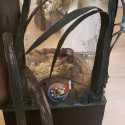
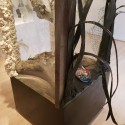
There’s something on your back is a half-globe with an octopus-like creature that has pounded “straws” into the earth to suck out the oil. There’s an illuminati eye pyramid for the creatures’ head, representing the fictitious secret order that controls the world. For me it represents the uncaring nature of humanity in its’ pursuit of wealth and power. Using foam core allowed me to create “building-like” forms that emulate city skylines and buildings. The body of the beast was designed to look industrial. I had never used silicone before in this way and found that I really enjoyed how the tentacles gave the form a distinctive character and tension, a dynamic feel.
I used a half globe instead a whole because I envisioned the tentacles wrapping around like they do and also to allow for easier mounting on a wall. I wanted to also give the creature sub-dominance, giving it a parasitic feel. I used a color palette that I felt was ominous and unpleasant to view for the creature. Red for blood, black and white for a deathly pallor, and gold sheen for duplicity. The earth’s colors were meant to represent a dying world, where green and healthy has disappeared. One of the many challenges I experienced was creating something that would resonate with people and move them to recognize the jeopardy we, and future generations, all face.
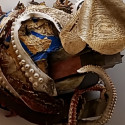
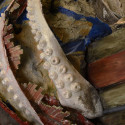
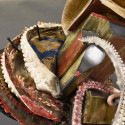
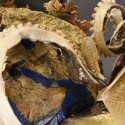
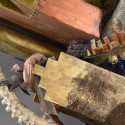
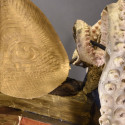
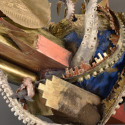
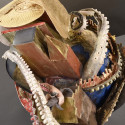
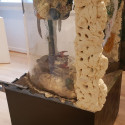
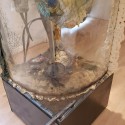
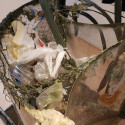
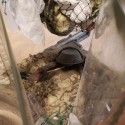
Feeding Time was created as a commentary on the plastics in the ocean, and how sea creatures are consuming it as if it were a source of food. This work isn’t meant to “knock” plastics, but our stewardship of said plastics. Plastic is one of the greatest inventions known to man; it saves countless lives since its invention and enables other technologies and processes. Our wasteful nature as humans is the problem and this work speaks of that very issue. I started by creating a crab and placing it in the middle of the work to give it dominance and to intrigue the viewer from afar. Once the viewer gets closer, they can see that it is made out of the very things hanging/floating above it. The idea is that the crab is becoming what it has consumed, plastic. The coral is made of spray foam and represents the dying marine ecology, where the plastics absorb heat from the sun and retain its energy, increasing the ambient temperature of the water around it, killing the algae within the corral. My goal was to balance the whole structure so that you don’t see it when you are up close. All you see are the creatures that have become more plastic-like.
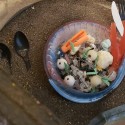
Lastly, I created a place setting that represents what we actually consume when we eat seafood today. According to current scientific studies, microscopic plastic particles are in everything we fish out of the ocean. Bon Appetit!